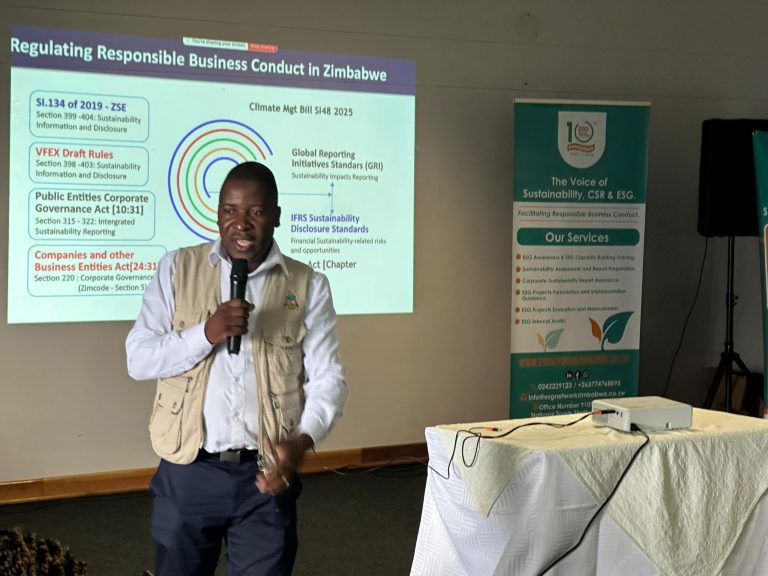


Beyond strategy formulation and sustainability reporting, the workshop placed strong emphasis on the practical realities of ESG implementation. Participants agreed that drafting policies and producing reports, while important, are only the starting points. The true measure of ESG maturity lies in how deeply it is embedded within the organisation’s structures, processes, and culture.
Effective ESG integration requires a shift from siloed initiatives to systems thinking. Rather than operating as a standalone department or compliance function, ESG must function as the organisation’s “business nervous system,” influencing decision-making at every level. This means embedding ESG considerations across governance structures, operating models, and organisational culture. In practice, ESG must be visible in the boardroom through oversight and strategic direction; in enterprise resource planning dashboards through measurable performance tracking; in procurement policies that shape supply chain standards; in executive performance contracts that tie sustainability outcomes to accountability; and in workforce engagement initiatives that reinforce shared values and purpose.
Hard-wiring ESG into the organisation demands deliberate structural changes. Board-level oversight and clearly defined accountability mechanisms ensure that sustainability priorities are aligned with corporate strategy. ESG key performance indicators linked to executive remuneration signal seriousness of intent and drive behavioural change. Integrated risk management frameworks must incorporate environmental and social risks alongside traditional financial risks, while ESG dashboards and digital tracking systems provide real-time performance insights. Continuous Monitoring and Evaluation loops further strengthen implementation by enabling data-driven learning and improvement over time.
The workshop also underscored that ESG implementation cannot follow a uniform template. Sector-specific realities demand tailored approaches. In the mining sector, organisations must prioritise maintaining their social license to operate and investing in environmental rehabilitation. Agribusinesses must integrate climate-smart agricultural practices and biodiversity protection into their value chains. Manufacturers are called upon to embrace circular economy principles that reduce waste and resource intensity. Financial institutions, meanwhile, must embed climate and sustainability risk into lending, underwriting, and investment decisions.
Failure to embed ESG meaningfully carries significant risks. Organisations may face restricted access to capital as investors increasingly screen for sustainability performance. Regulatory penalties can arise from non-compliance with evolving disclosure standards. Reputational damage may erode brand trust and stakeholder confidence, while talent loss becomes more likely as employees gravitate toward purpose-driven employers. Ultimately, market exclusion is a real possibility in global supply chains that demand verified ESG performance.
The message emerging from Vumba was unequivocal: the cost of transition is lower than the cost of inaction. Organisations that proactively embed ESG into their systems and culture position themselves for resilience, competitiveness, and long-term success in an increasingly sustainability-driven marketplace.
Contact Us
Email: admin@esgnetworkzimbabwe.co.zw
Phone: 0774 768 895 | 0782 005 030 | 0242 229 123