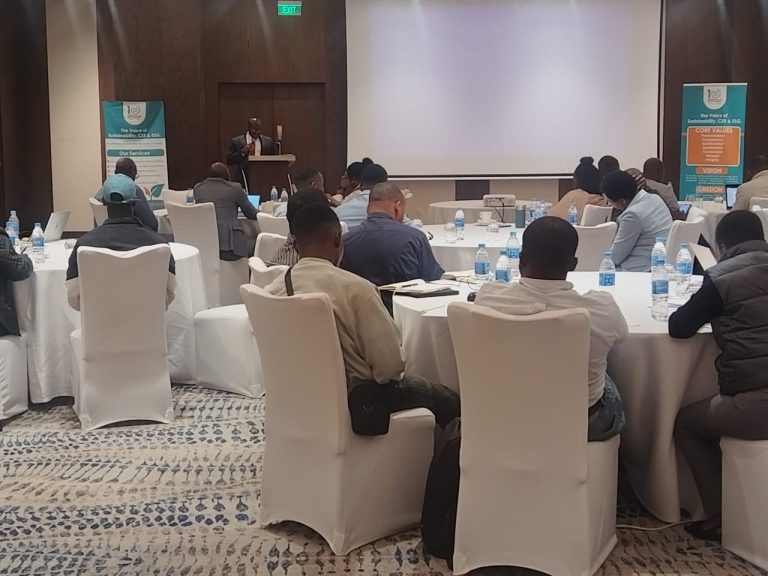


Artificial Intelligence is no longer a distant concept. It is already reshaping how organisations measure, report, and act on their Environmental, Social, and Governance commitments. For Zimbabwe, the question is not whether AI will intersect with ESG — it already does. The real question is whether our institutions are ready to harness it responsibly.
Setting the Scene
Zimbabwe’s sustainability agenda is accelerating. Companies operating across financial services, mining, insurance, agriculture, and infrastructure face growing pressure from regulators, investors, and communities to demonstrate credible ESG performance — not just aspiration.
At the same time, AI is becoming embedded in the tools that organisations use to collect data, model risk, automate reporting, and engage stakeholders. These two trajectories — the ESG imperative and the AI revolution — are converging in ways that Zimbabwe’s practitioners need to understand and actively shape.
Zimbabwe has taken early steps in this space. The launch of the National AI Strategy (2026–2030) and the completion of a UNESCO AI Readiness Assessment signal policy-level acknowledgement that AI governance matters. But strategy documents alone are not enough. The real test is implementation — and that is where ESG professionals have a critical role to play.
The Opportunities AI Offers ESG Practice
Used well, AI can be a significant enabler for ESG performance and reporting. Four areas stand out as particularly relevant for Zimbabwe:
| Theme | Key Consideration |
| Automated ESG Reporting | AI tools can streamline IFRS S1/S2 disclosures, sustainability metrics, and compliance checks — reducing the manual effort and margin for error that currently constrain many organisations. |
| Predictive Analytics | AI can model climate-related financial risks, supply chain disruptions, and social impact trends — giving decision-makers earlier and more granular insight than traditional methods allow. |
| Operational Efficiency | AI-driven compliance monitoring reduces human error, improves audit trails, and strengthens the credibility of disclosures to regulators and investors alike. |
| Stakeholder Communication | AI-powered dashboards and reporting interfaces can make complex ESG data more accessible to boards, investors, communities, and regulators — closing the communication gap that often undermines even strong ESG performance. |
The Risks We Cannot Afford to Ignore
The same capabilities that make AI powerful also make it dangerous when deployed without adequate governance. Zimbabwe’s ESG community needs to be clear-eyed about the risks:
Data Privacy and Governance
AI systems depend on data — and poor data governance can expose sensitive employee, environmental, and financial information. Without robust privacy frameworks, AI-enabled ESG reporting can become a liability rather than an asset.
Algorithmic Bias
If AI systems are trained on biased or unrepresentative datasets, they risk reinforcing inequalities — particularly in Social and Governance dimensions. An AI tool that systematically underweights the interests of vulnerable communities is not an ESG tool; it is a governance risk.
Regulatory Uncertainty
Zimbabwe currently lacks AI-specific ESG legislation. This creates a grey zone where companies may deploy AI in ways that appear compliant under existing frameworks but that could quickly fall foul of emerging standards — both locally and under frameworks such as the GRI Standards, TCFD, and IFC Performance Standards.
Workforce Displacement
Automation of audit and compliance functions carries real social consequences. ESG professionals — and the organisations that employ them — must engage seriously with the workforce implications of AI adoption, rather than treating displacement as an externality.
The Capacity Challenge
Perhaps the most significant issue facing Zimbabwe is not the sophistication of the AI tools available — it is the gap in local capacity to deploy and govern them responsibly.
Most organisations in Zimbabwe — including those in sectors most exposed to ESG risk such as mining, insurance, and agriculture — do not yet have the internal expertise to evaluate AI tools critically, integrate them into ESG frameworks, or identify when an AI-generated output should be challenged rather than trusted.
Compounding this is the infrastructure challenge. Inconsistent data availability, weak digital connectivity in key sectors, and limited investment in data management systems mean that the foundational requirements for effective AI deployment are often missing.
These are not reasons for paralysis. They are the starting point for a clear capacity-building agenda.
What This Means for ESG Practitioners
For members of the ESG Network Zimbabwe community, the AI agenda is directly relevant — not as a technology issue, but as a governance and practice issue. Consider the following practical steps:
- Develop AI Literacy: ESG practitioners do not need to be data scientists. But they do need to understand how AI tools work well enough to ask the right questions: What data was this model trained on? What are its limitations? Who is accountable for its outputs?
- Embed AI in Assurance Frameworks: Internal auditors and ESG advisors should be actively considering how AI-generated disclosures are verified, how model risk is assessed, and how boards are held accountable for AI-driven ESG decisions.
- Engage the Regulatory Conversation: Zimbabwe’s AI Strategy creates an opening for the ESG community to shape how AI governance develops in this country. Network members are well-placed to contribute practitioner perspectives to that conversation.
- Insist on Ethical Standards: Whether advising clients or managing internal ESG programmes, practitioners should apply the same ethical rigour to AI tools as to any other significant business decision — including scrutiny of bias, privacy, and social impact.
Contact us on:
Email: admin@esgnetworkzimbabwe.co.zw
Call: 0774 768 895 | 0782 005 030 | 0242 229 123